Almost every business that considers custom software asks the same question sooner or later: is this something for our industry? The usual answer is a list of sectors. That list says less than it seems. The organisations that gain the most from custom software share a handful of traits, and you will find those traits across very different industries.
Below we walk through those traits and show what they look like in three sectors we work in ourselves: manufacturing, infrastructure and field service, and financial and legal services. Work somewhere else? Then read the traits above all. They matter more than the name of your sector.
Four traits that matter more than the sector
Look at the organisations where custom software made the difference, and the same combination keeps turning up:
- Processes so specific that off-the-shelf software can only handle them with workarounds.
- Rules or guidelines that require every step to be recorded and provable afterwards.
- Decisions that depend on information that keeps changing.
- Data scattered across systems that don’t know each other.
That last trait shows up in almost every custom software project, and it is the one most often underestimated. We covered what goes wrong when systems work past each other in an earlier article about systems that don’t communicate. In each sector a different trait weighs heaviest, and that determines where custom software starts.
Manufacturing: many systems, little cohesion
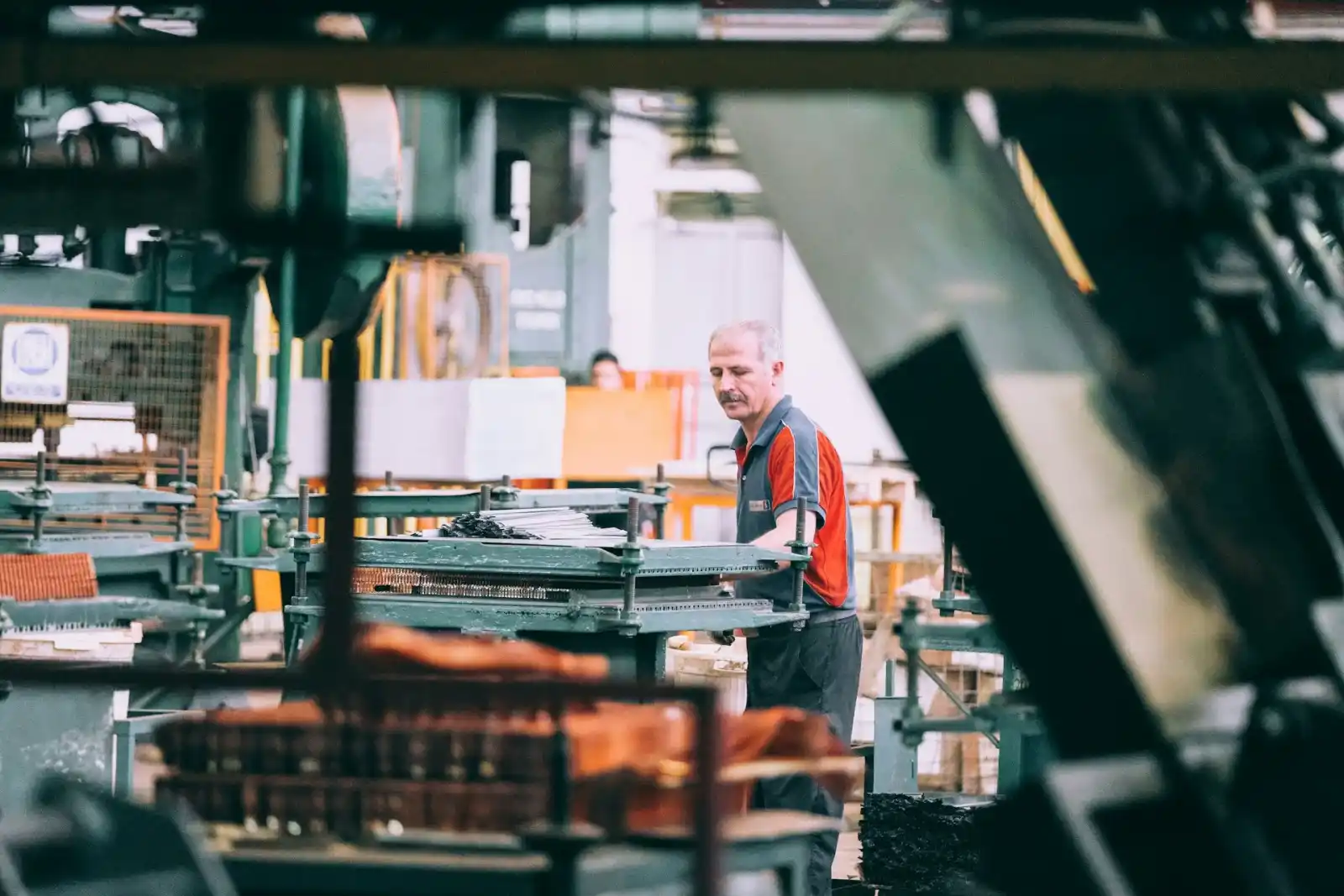
A manufacturing business rarely runs on a single system. Planning sits in the ERP, machine data in the machine supplier’s software, quality checks on forms, and current stock in a spreadsheet someone updates every morning. Every handover between those layers is manual work, and every manual step is a chance for errors and downtime. With several sites, another layer comes on top: every plant reports slightly differently, so nobody can compare them properly.
Here the fourth trait weighs heaviest: scattered data. Custom software connects those layers. Machine data is collected automatically, stock is linked to purchasing, and management sees production as it runs now, not as it ran last month. You can see what that looks like in our case on Manufacturing in your pocket: a platform that puts the performance of plants, lines and stations side by side, so a manufacturer steers on what is happening on the shop floor today.
Manufacturers who come to us with this question rarely want a new ERP. They want cohesion between what is already there, and that is exactly where custom software alongside standard packages proves its worth.
Infrastructure and field service: the work happens outside, the admin inside
For contractors, installers and other organisations with crews on site, the issue lies in the distance between the work and the administration. Outside, things get dug, placed, connected or collected again. What was done, the crew writes down on paper or in an app disconnected from everything else, and back at the office someone later copies it into planning, stock and invoicing. The picture at the office therefore lags behind reality, and every transcription is a moment where something can shift or go missing.
Two traits apply at once here: decisions based on information that changes by the hour, and processes too specific for a standard package. A planner who has to move crews today gains nothing from yesterday’s status. Custom software records the work at the moment it happens and lets planning, materials and invoicing follow from that same record. For VAF Infra, which provides temporary traffic measures, we develop a system that connects office and field crews, from work order to invoice. For Soli Infratechnik we did the same for fibre-optic rollout in Germany, so that progress and settlement came from the same recorded work.
Financial and legal services: accountability drives the design
In finance and law, record-keeping is not a side task but the core of the work. Regulators ask for reports, guidelines prescribe how a calculation must be made, and privacy rules determine who may see which data. Off-the-shelf software is built for the average organisation, and accountability is never average.
Here the second trait weighs heaviest. Custom software reverses the order: the rules your organisation must meet sit in the design itself. Reports come out of the system instead of a late-night spreadsheet session, a calculation can be traced step by step afterwards, and who may open which file is a setting, not a verbal agreement.
For Swishfund, a provider of SME financing, we develop the loan application and the bank integrations that read along behind it. With Letselinzicht we developed, together with a personal injury law firm, a calculation tool that performs personal injury calculations according to the applicable guidelines and makes them traceable. Two very different organisations, the same trait at the root.
You’ll recognise it in your processes, not your sector
You may not work in any of these sectors. That says little. A wholesaler with several warehouses, an installation company with service contracts, a consultancy where every assignment gets its own way of working: the traits don’t care about industry boundaries. Go through the list at the top once more. If two or more sound familiar, chances are a standard package can only handle your work with workarounds, and those workarounds are by now costing time and money.
The first step is then not a quote, but getting clear which process weighs heaviest and which data needs to come together in one place for it. You can read how we approach such a question, from the first conversation to a working application, on our custom applications service page.