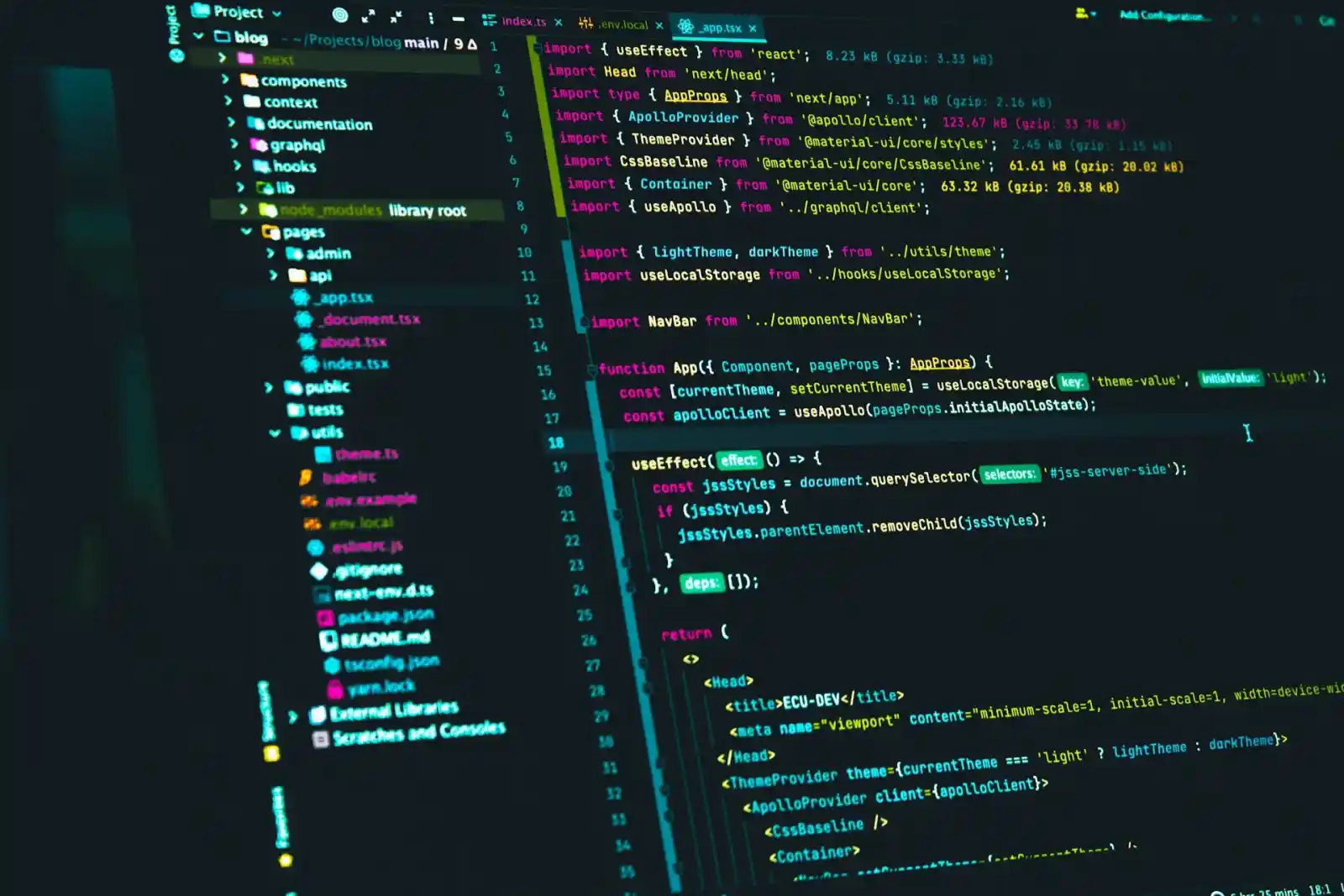
When you commission a web application, you rarely choose the programming language yourself: your software partner proposes one. Yet you carry the consequences, for years. The language helps determine what maintenance costs, how easily you find developers, and whether you can ever switch partners without having the application rebuilt.
This article first answers which programming languages are common in web application development, and then gives you a framework for testing your agency’s proposal. You don’t need to be technical for that.
Which programming languages are used for web application development
A web application has two layers. The browser side is what your users see and click; the server side processes the data, applies the business rules and talks to the database and other systems.
On the browser side there is little to choose. JavaScript is the language browsers run themselves, these days usually written as TypeScript: a stricter variant that catches errors before the code runs. Frameworks such as React and Vue.js then determine how the interface is built.
On the server side the choice is wider. The languages you will most often find in proposals for business applications:
- PHP, almost always with a framework such as Laravel or Symfony. Widely used for web applications and portals.
- Python, with frameworks such as Django or FastAPI. Strong wherever data and AI play a role, because most of the tooling for that is written in Python.
- C# on .NET, the logical choice in organisations that already run on Microsoft technology.
- Java, common in large organisations with long-running systems.
- JavaScript on the server through Node.js, often chosen when a team wants to work in TypeScript on both sides.
The database is usually a separate choice, PostgreSQL or MySQL for instance, and is independent of the language. All of these languages are mature; business-critical systems run on each of them every day. So the language named in the proposal says little, the reasoning behind it says everything.
The framework and the version say more than the language
Don’t just ask which language, ask which framework and which version. A framework is the construction kit a team works with in that language: it handles logins, forms, security and the connection to the database. A framework with a large community behind it gets security updates and has plenty of developers who know their way around it.
The version is the quiet risk. Language and framework versions have a support period; after that, security updates stop. An application delivered on a version that is already nearing the end of that period hands you an upgrade project within a year that was never in the quote.
Developer availability determines your freedom
The most important test is not technical but economic: how many people will be able to maintain this system in five years? For the languages above, that pool is large. Developers can be found and agencies can take over each other’s work.
A few proposals deserve extra attention. Not because they are wrong by definition, but because they narrow that pool:
- a language you don’t encounter in any other proposal;
- a framework the agency developed itself and that nobody outside the agency knows;
- a closed low-code or no-code platform, where the application only exists inside that platform;
- a framework that has only just been released and is not yet proven in production.
In the worst case, exactly one party remains that can maintain your application: your current supplier. Technology chosen on impression rather than on the work is one of the patterns in five reasons why web applications fail.
The language has to fit what you already have
A language choice never stands alone. If your organisation runs on Microsoft technology, with your own administrators who know it, C# on .NET is a more logical proposal than a language nobody in-house knows. If you already have systems in PHP or Python, building on those is often wiser than introducing a third language.
Look at the integrations too. A web application that has to talk to your ERP, CRM or accounting package benefits from a language in which ready-made connectors for those systems already exist. Also weigh where the application will run and who will manage it.
Python as soon as AI or data is part of your plans
Most of the tooling for AI and data processing is written in Python. If AI is on your roadmap, such as processing documents automatically or an assistant that works with your own data, your whole application does not need to be in Python. The usual approach is a separate Python service alongside the existing application: the web application in the language that suits the team and the landscape, the AI components in Python.
What the language does not determine
Whether your application is still secure, fast and adaptable in five years depends less on the language than on what is arranged around it. Outdated, unmaintainable code arises in every language; well-maintained systems exist in every language. The difference lies in automated tests, up-to-date documentation, a streamlined way of releasing, and clear agreements on who owns the source code.
We covered those subjects separately before: how to prevent vendor lock-in, with the questions on ownership and handover; why good documentation keeps you independent of your development team; and which DevOps practices a software partner needs to have in place. Don’t let a conversation about the language replace those questions.
How to test the proposal at the table
You don’t need to read code to judge a language choice. These questions reveal whether it has been thought through:
- Why this language for this challenge, and what would the alternative have been?
- Which framework and which version, and until when is it supported?
- How many other parties could take this over?
- How does the choice fit the systems and the people we already have?
- What happens to this choice if we add AI or heavier data processing later?
A partner who answers these concretely, in terms of what it delivers for you, has made the choice based on the work and not out of habit. If the answer stops at ‘this is what we always use’, that tells you something too.
For web applications we work with Laravel, Vue.js, React, Node.js, TypeScript and PostgreSQL ourselves, and with Python for data and AI; the team chooses what fits the project. The strongest proposal rarely starts with the language. It starts with your challenge, your existing systems and the people who work with them. You can read how we approach that under web applications and portals.